

The Dispatch: Week 11
VW and Rivian team up with Qualcomm to challenge Tesla, TomTom undergoes a leadership shake-up, and cybersecurity becomes a growing regulatory and developmental focus.

SDV Insider — March 13, 2026
This week’s developments highlight how the industry is reorganizing around software platforms, shared compute architectures, and the data infrastructure behind them. Volkswagen and Rivian’s alignment with Qualcomm signals a growing push to build collaborative alternatives to Tesla’s vertically integrated model.
Meanwhile, shifts among key technology suppliers—from digital mapping platforms to cybersecurity solutions—underscore a broader truth: the SDV transition is no longer just about vehicles. It’s about ecosystems.
For automakers, suppliers, and software teams alike, the competitive edge increasingly lies in how fast—and how securely—they can build and scale software platforms.
The race to define the software-defined vehicle stack is accelerating.

🚀 Top Story
VW–Rivian–Qualcomm Alliance Signals New SDV Ecosystem Play
In a significant move poised to reshape the competitive landscape, Volkswagen and Rivian are reportedly standardizing their vehicle “brains” using high-performance Qualcomm silicon—an effort to create a robust Western alternative to Tesla’s tightly integrated software stack.
The collaboration goes beyond traditional supplier relationships, signaling a deeper architectural partnership around high-performance compute platforms for SDVs. For Volkswagen, the move could accelerate its software-defined ambitions by pairing Rivian’s agile development culture with Qualcomm’s expertise in automotive compute platforms.
For Rivian, the alliance provides valuable scale and validation—critical advantages as the company continues expanding its vehicle lineup and technology stack.
Our Take:
This partnership reflects a broader shift in the industry: the “build vs. buy” debate is evolving into “build with strategic partners.” Few automakers can replicate Tesla-style vertical integration alone. Expect more alliances built around shared compute platforms, standardized architectures, and collaborative software ecosystems.
⚙️ Industry Pulse
Mapping Pioneer TomTom Enters New Chapter with CEO Transition
TomTom is undergoing a major leadership transition as co-founder and long-time CEO Harold Goddijn prepares to step down, with Chief Revenue Officer Mike Schoofs set to take over leadership in April. The move comes as the mapping pioneer continues its transformation from consumer navigation devices toward AI-driven mapping platforms for ADAS and autonomous driving.
The shift reflects broader changes in the automotive mapping market, where high-definition maps and location data increasingly serve as foundational inputs for ADAS, autonomy, and connected vehicle services.
For suppliers like TomTom, the next phase of competition centers on AI-powered mapping, real-time data ingestion, and deeper integration with vehicle software stacks.

Cybersecurity Tightens with New Standards and Solutions
The automotive industry is intensifying its focus on cybersecurity as new regulations come into force for vehicles produced from 2026 onward. Europe’s evolving rules introduce stricter requirements for vehicle cyber-risk management, secure software updates, and lifecycle vulnerability monitoring.
OEMs increasingly identify cybersecurity as one of their most critical engineering challenges over the next five years. In response, suppliers are expanding their offerings: Microchip Technology recently extended its Trust Platform to help manufacturers meet new compliance requirements through secure authentication ICs and cryptographic key management services.
As Deloitte notes, every additional connected feature expands the vehicle attack surface—making cybersecurity a core architectural consideration for SDV programs.
Accelerating SDV Development with Digital Twins
Synopsys has launched its Electronics Digital Twin (eDT) platform designed to accelerate software-defined vehicle development. The cloud-based environment enables OEMs to simulate and validate electronic systems earlier in the development cycle, potentially completing up to “90% of software validation before physical hardware becomes available”.
This shift toward virtual validation reflects the increasing complexity of SDV architectures, where distributed compute platforms, zonal controllers, and multi-domain software stacks demand earlier and more scalable testing strategies.
Meanwhile, Microchip Technology and Vector are expanding their collaboration on embedded software for SDV control units, providing pre-integrated hardware and software support for resource-constrained ECUs.
💼 Company Moves & Partnerships
Stellantis Rebrands Mobilisights to Focus on Connected Data Solutions
Stellantis’s data-as-a-service unit, Mobilisights, has rebranded as Mobilisights Connect, expanding its mission to deliver enterprise software solutions powered by vehicle data.
The move highlights the growing importance of vehicle-generated data as a strategic asset, enabling applications ranging from fleet optimization and insurance analytics to smart-city integration.
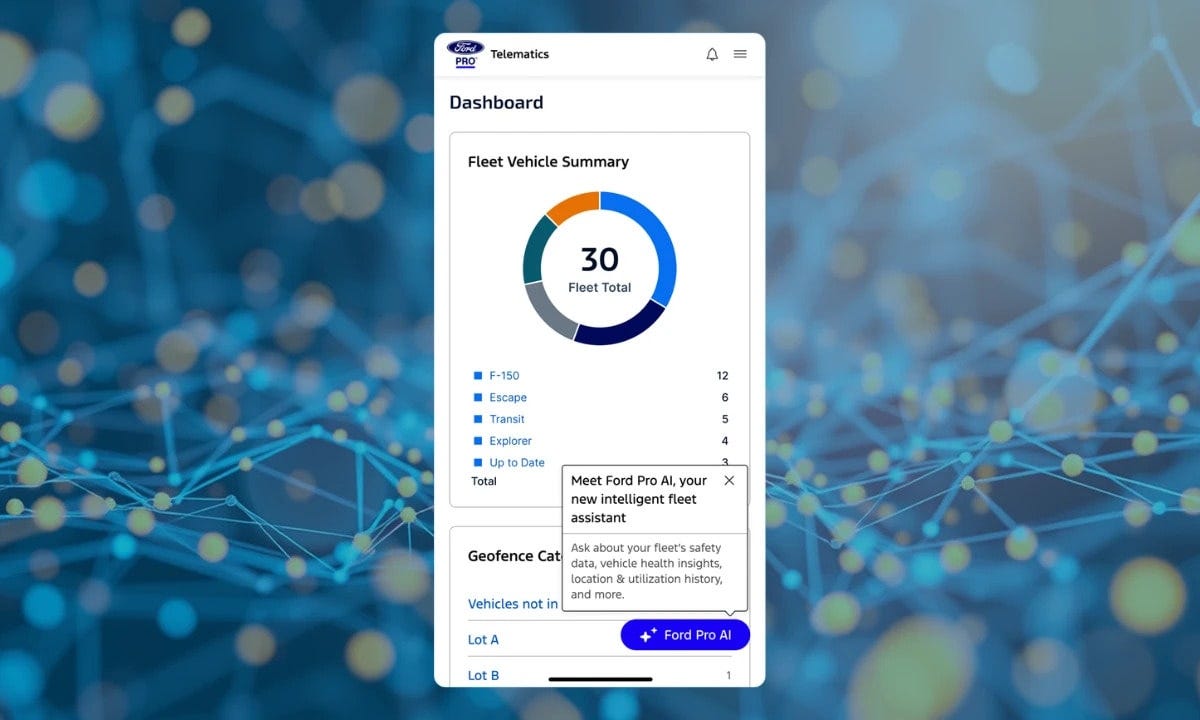
Ford Pro Debuts AI Chatbot for Telematics
Debuted at Work Truck Week this week, Ford . is introducing an AI-powered chatbot within its Ford Pro Telematics platform, designed to help commercial fleet operators diagnose issues, answer operational questions, and streamline fleet management workflows.
The feature reflects a broader push to embed generative AI capabilities into fleet software platforms—leveraging vehicle telemetry and operational data to improve uptime and reduce diagnostic complexity.
Motive Joins Holman’s Telematics Integration Network
AI fleet platform Motive has become the first company to join Holman’s new Telematics Preferred Integration Network Program. The initiative aims to create deeper interoperability between telematics providers and fleet management systems, helping fleets optimize vehicle utilization, safety, and operational efficiency.
📊 Market & Reports
Vehicle Software Operations Market Poised for Significant Growth
A new report forecasts the global vehicle software operations market will reach $62.8 billion by 2036, driven by the continued transition toward software-defined vehicle architectures.
Key drivers include the growing importance of over-the-air updates, cybersecurity frameworks, and continuous vehicle performance monitoring. The outlook reinforces a broader industry shift: automotive value creation is moving rapidly from hardware toward software platforms and digital services.
👋 That’s a Wrap
This week’s news reinforces how rapidly the automotive industry is reorganizing around software platforms. Strategic alliances, leadership shifts across critical suppliers, and growing regulatory pressure around cybersecurity all point to a future where software capability—not hardware alone—defines competitive advantage.
The pace of change isn’t slowing. If anything, it’s accelerating.
— The SDV Insider Crew 🚗💨